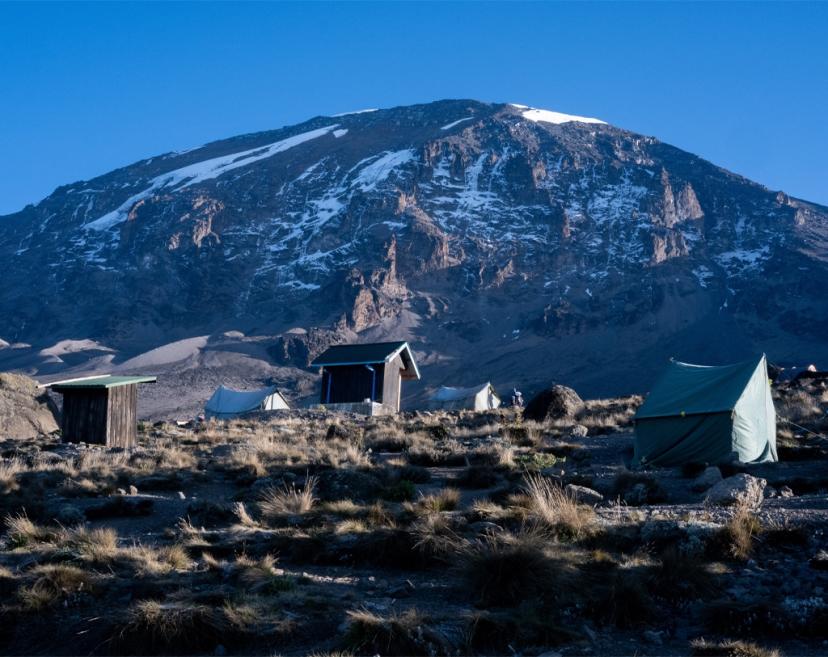
Marangu Route: Kilimanjaro's Classic Coca-Cola Route
The Marangu Route holds a special place in Kilimanjaro's history. It is the oldest, most established route up the mountain, the only route offering hut accommodation instead of tents, and the most affordable option for summiting Africa's highest peak. It is also the only route where you ascend and descend on the same path, which divides opinion - some climbers appreciate the familiarity, while others prefer the variety of routes that descend via a different path.
The Marangu Route's reputation has suffered from its lower success rate on the standard 5-day itinerary (~65%), which has led some to dismiss it as the "tourist route." This is misleading. The low success rate is a consequence of the itinerary's rapid altitude gain, not the route's terrain. Climbers who opt for the 6-day itinerary - adding an extra acclimatization day at Horombo Hut - achieve success rates around 85%, comparable to the Machame Route.
Route Overview
| Detail | Information |
|---|---|
| Starting Gate | Marangu Gate (1,860m) |
| Summit Approach | Via Kibo Hut (direct) |
| Descent | Same route (Marangu) |
| Duration | 5-6 days (6 recommended) |
| Distance | ~72 km (return) |
| Accommodation | Mountain huts |
| Difficulty | Moderate (easiest terrain) |
| Scenery | Good - less varied than southern routes |
| Traffic | Moderate |
| Success Rate | 65% (5-day), 85% (6-day) |
Day-by-Day Itinerary (6 Days)
Day 1: Marangu Gate (1,860m) to Mandara Hut (2,720m)
Distance: 8 km | Hiking Time: 3-5 hours | Elevation Gain: 860m
The trek begins at Marangu Gate, the most developed of all Kilimanjaro starting points, with a small museum, gift shop, and registration office. The well-maintained trail leads through beautiful montane rainforest on a wide, gentle path. This is the easiest first day of any Kilimanjaro route. Mandara Hut is a cluster of A-frame wooden huts in a forest clearing, accommodating up to 60 climbers. A short side trail leads to the Maundi Crater viewpoint - a worthwhile 20-minute detour with views of the plains below.
Day 2: Mandara Hut (2,720m) to Horombo Hut (3,720m)
Distance: 12 km | Hiking Time: 5-7 hours | Elevation Gain: 1,000m
The longest trekking day, crossing from forest into the heath and moorland zone. The trail is well-graded and follows a clear path through giant heather and open grassland. Views of both Kibo (the main summit cone) and Mawenzi (the jagged secondary peak) are excellent on clear days. Horombo Hut is the largest camp on the mountain, accommodating up to 120 climbers in its cluster of A-frame huts. It sits in a spectacular location between the two peaks.
Day 3: Acclimatization Day at Horombo Hut (3,720m)
Distance: Optional walks | Hiking Time: 2-4 hours | Elevation Gain/Loss: Variable
This extra day is what makes the 6-day itinerary so much more effective than the 5-day version. You spend a second night at Horombo, allowing your body a full additional day to acclimatize to 3,720 metres. Most climbers take an acclimatization hike toward Mawenzi Tarn (4,600m) before returning to Horombo to sleep. This "walk high, sleep low" strategy significantly reduces the risk of altitude sickness on summit night.
Day 4: Horombo Hut (3,720m) to Kibo Hut (4,703m)
Distance: 10 km | Hiking Time: 5-7 hours | Elevation Gain: 983m
The trail crosses the "saddle" - a vast, barren alpine desert between Kibo and Mawenzi. The landscape is stark and lunar, with minimal vegetation and sweeping views. The terrain is relatively flat for most of the day before climbing steeply to Kibo Hut, the final hut before the summit. Kibo Hut is basic - a stone building with bunk beds - and sits in an exposed, windswept position. You eat an early dinner and rest before the midnight wake-up.
Day 5: Kibo Hut (4,703m) to Uhuru Peak (5,895m) to Horombo Hut (3,720m)
Distance: 16 km | Hiking Time: 12-16 hours | Elevation Gain/Loss: +1,192m / -2,175m
Summit night begins around midnight. The route climbs steep switchbacks on scree to reach Gilman's Point (5,681m) on the crater rim - the steepest and most physically demanding summit approach of any route. From Gilman's Point, it is approximately 2 hours along the crater rim via Stella Point to Uhuru Peak. After the summit, you descend all the way back to Horombo Hut, passing through Kibo Hut for a break along the way.
Day 6: Horombo Hut (3,720m) to Marangu Gate (1,860m)
Distance: 20 km | Hiking Time: 5-7 hours | Elevation Loss: 1,860m
The final descent retraces your ascent through moorland and forest to Marangu Gate. The distance is significant but mostly downhill. You pass through Mandara Hut for a lunch break. At the gate, you receive your summit certificate and meet your vehicle for the transfer to Moshi.
Why Choose Marangu
Hut accommodation: If you dislike camping or want the comfort of a roof, walls, and a bunk bed, Marangu is your only option. The huts provide genuine shelter from weather that tents cannot match.
Most affordable: Fewer porters are needed (no tent equipment to carry) and hut fees are included in the park fees, making Marangu the most budget-friendly route.
Gentlest terrain: The trail gradients are the most moderate of any route, making Marangu accessible to climbers who are fit but not experienced trekkers.
Historical significance: Marangu was the route used by Hans Meyer for the first recorded summit in 1889. There is a sense of history walking in those footsteps.
What to Consider
Rapid ascent on 5-day itinerary: We do not recommend the 5-day option. The extra day at Horombo is inexpensive and dramatically improves your summit odds and safety.
Less scenic variety: Because you ascend and descend on the same path, you see the same scenery twice. Routes like Machame and Lemosho offer more visual variety.
Steepest summit approach: The direct climb from Kibo Hut to Gilman's Point is arguably the most demanding summit night of any route.
Huts mean sharing: You share sleeping quarters with other climbers. Earplugs and a sleep mask are essential.